PTFE là một chủ đề kỹ thuật thực tiễn khi bạn cần so sánh các phương án, kiểm tra các giới hạn và lựa chọn quy trình có mức độ rủi ro thấp hơn.
When printing with standard filaments like PLA or PETG, a brass nozzle performs well. However, abrasive filaments containing carbon fiber, glass fiber, or metal particles will rapidly wear through brass, causing dimensional inaccuracies and eventual print failure.
What Makes Filaments Abrasive
Carbon fiber reinforced filaments are highly abrasive with fiber hardness around 200 HB. Glass fiber is even harder at 500 HB. Metal-filled and glow-in-the-dark filaments also cause rapid wear. Our Sợi PA6-CF is optimized for reliable printing.
Nozzle Materials Compared
Brass nozzles (hardness 55-100 HB) last 10-50 hours with CF filament. Hardened steel (700-900 HB) provides 200-500 hours of use. Ruby nozzles (1500+ HB) offer unlimited wear life for production environments.
Print Settings for Hardened Nozzles
Increase temperature by 5-10°C vs brass due to lower thermal conductivity. Extrusion may need 2-5% more flow. First layer settings may require adjustment.
Source Quality Abrasive Filaments
As a specialized source manufacturer, we supply carbon fiber and glass fiber reinforced filaments with consistent diameter tolerance (±0.03mm). Liên hệ với chúng tôi for technical support and samples.
Nhận báo giá miễn phí
Hãy điền vào biểu mẫu dưới đây và các kỹ sư của chúng tôi sẽ phản hồi trong vòng 24 giờ.
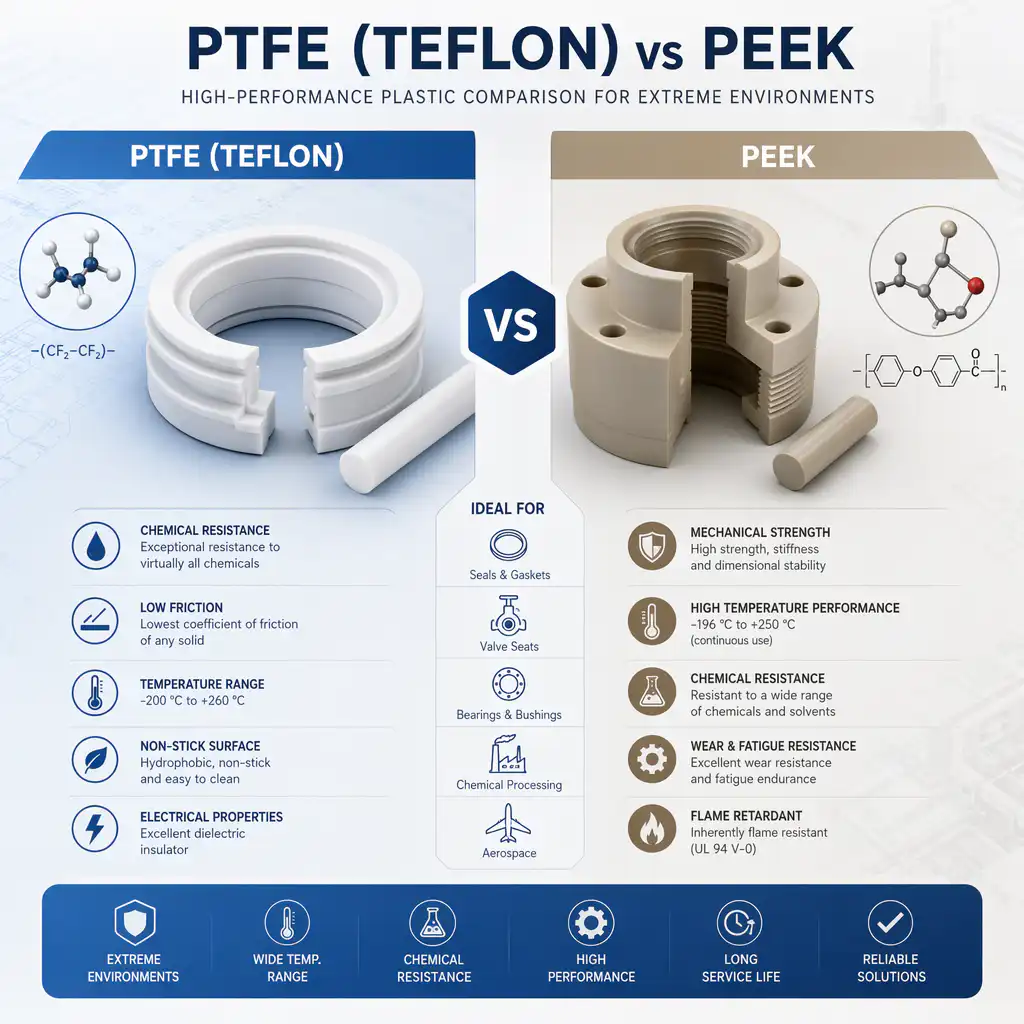
PTFE vs PEEK Material Decision Table
| Yêu cầu | PTFE | PEEK |
|---|---|---|
| Friction and release | Very low friction and strong non-stick behavior | Low friction with much higher structural strength |
| Temperature and load | Excellent chemical and temperature resistance, but limited stiffness under load | High continuous-use capability with better stiffness, wear and creep resistance |
| Processing | Often machined or compression-processed; filled grades change behavior | Requires controlled high-temperature molding, machining or printing |
| Part selection | Seals, liners and low-friction interfaces | Loaded bushings, insulators and precision structural wear parts |
Choose from the completed load, temperature, friction and chemical envelope. Confirm grade, filler, surface finish and dimensional test method rather than relying on the base polymer name alone.
Câu hỏi thường gặp
Khi nào thì bài viết “PTFE (Teflon) so với PEEK — So sánh các loại nhựa hiệu suất cao trong môi trường khắc nghiệt” là một lựa chọn phù hợp?
PTFE (Teflon) so với PEEK — So sánh các loại nhựa hiệu suất cao trong môi trường khắc nghiệt là một lựa chọn phù hợp khi tốc độ lặp lại nhanh, hình học phức tạp, chi phí khuôn mẫu thấp hoặc sản xuất số lượng nhỏ được ưu tiên hơn so với chi phí đơn vị của chi tiết đúc.
Cần kiểm tra những yếu tố nào trước khi lựa chọn giữa PTFE (Teflon) và PEEK — So sánh các loại nhựa hiệu suất cao dành cho môi trường khắc nghiệt?
Kiểm tra kích thước chi tiết, tính chất vật liệu, độ nhám bề mặt, dung sai kích thước, mức độ tiếp xúc với nhiệt, hướng tải trọng và xem có cần xử lý sau gia công hay không.
So sánh giữa PTFE (Teflon) và PEEK — so sánh các loại nhựa hiệu suất cao dành cho môi trường khắc nghiệt — có gì khác biệt so với gia công CNC?
In 3D có thể tạo ra các hình dạng phức tạp một cách nhanh chóng, trong khi gia công CNC thường mang lại độ bền cao hơn cho các bề mặt chính xác, dung sai chặt chẽ hơn và sử dụng vật liệu đạt tiêu chuẩn sản xuất.
Yếu tố nào ảnh hưởng đến giá thành của PTFE (Teflon) so với PEEK — So sánh các loại nhựa hiệu suất cao trong điều kiện môi trường khắc nghiệt?
Chi phí phụ thuộc vào vật liệu, thể tích in, thời gian in, độ dày lớp, việc tháo khung đỡ, hoàn thiện, kiểm tra và số lượng chi tiết trong mô hình.