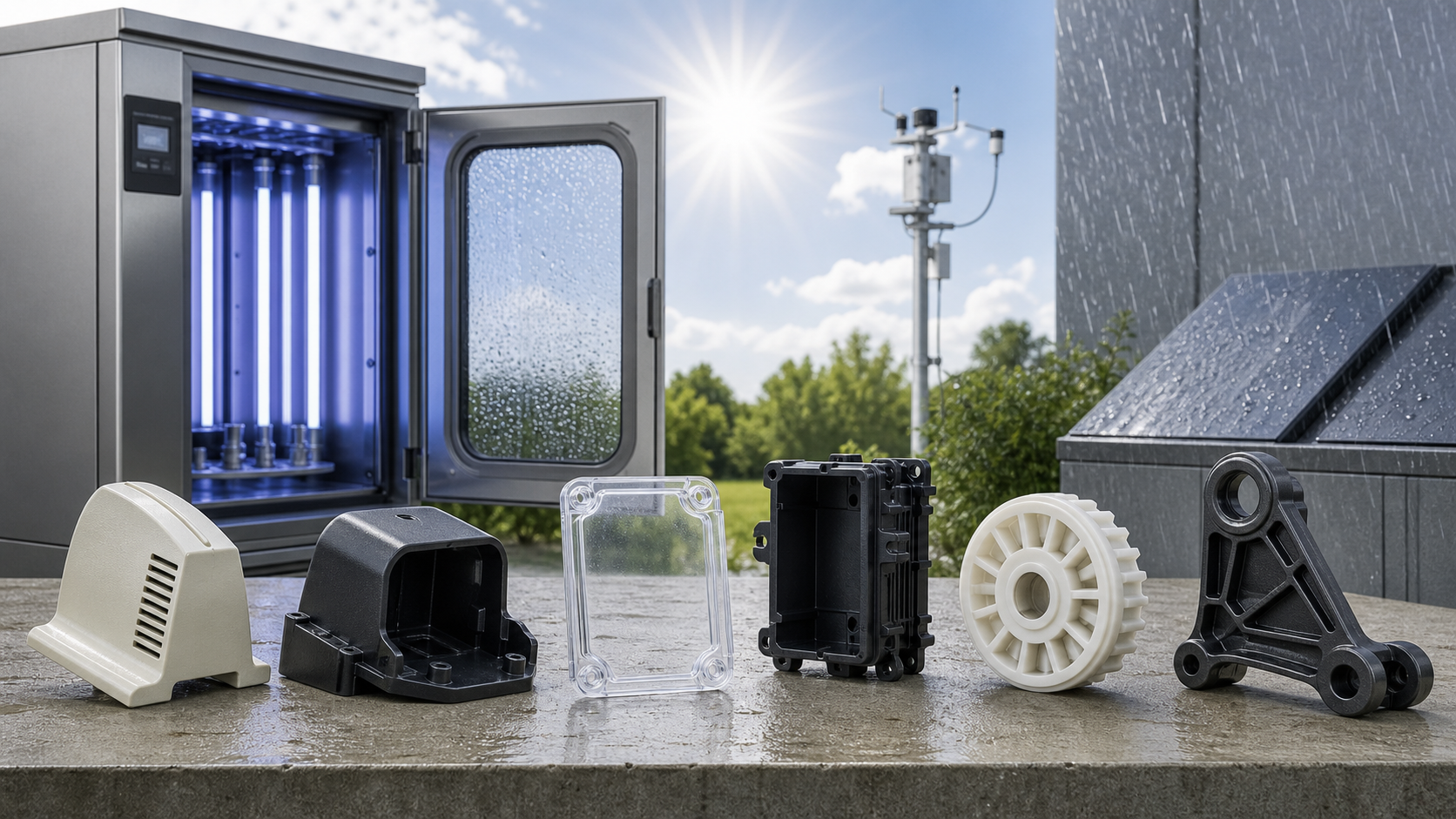
Outdoor plastic selection should be based on UV retention, moisture, temperature cycling, impact, color stability, chemicals and service life, not on a generic “UV resistant” label. ASA, UV-stabilized ABS, PC, PP, PBT and selected nylon grades can all be useful, but each needs grade-specific evidence and design controls.

Outdoor Material Selection at a Glance
| Material direction | Potential advantage | Risk to validate |
|---|---|---|
| ASA | Good outdoor appearance and weathering direction for many molded or printed parts. | Grade, color, impact retention and process route. |
| UV-stabilized ABS | ABS processing and finish with added outdoor protection. | Actual UV package, color retention and exposure duration. |
| Máy tính cá nhân | Impact resistance and transparent or high-performance options. | Stress cracking, yellowing, moisture and chemical exposure. |
| PP | Low density, chemical resistance and practical molding. | UV package, stiffness, creep and temperature cycling. |
| PBT | Dimensional and electrical performance in selected applications. | Hydrolysis, UV package, glass orientation and grade evidence. |
| Nylon | Strength and reinforced options for structural outdoor components. | Moisture, hydrolysis, UV retention and dimensional change. |
What UV and Weathering Can Do to Plastic
Ultraviolet exposure can break down polymer chains or additives at the surface. The visible result may be fading, chalking, gloss loss, cracking or embrittlement, but a part can also lose impact or fatigue performance before the appearance looks unacceptable. Heat, oxygen, humidity, salt, cleaners and mechanical stress can accelerate the change.
Color alone is not proof of UV performance. Carbon black can help protect some polymers, while pigments and stabilizers can change heat, dispersion and appearance. A light-colored part may require a different formulation from a black part even when the base resin is the same.
Outdoor Design and DFM Considerations
- Use drainage and vent paths so water does not remain trapped against the part.
- Allow for thermal expansion and moisture movement in long covers and clips.
- Review wall transitions, ribs and fastener bosses for stress concentration.
- Protect cut edges, inserts and joined interfaces where the material may be exposed.
- Define color, gloss, texture, chalking and crack limits as separate requirements.
- Check seal compression and clearance after temperature and humidity cycling.
Outdoor parts often fail at fasteners, seams or stress points rather than in the broad flat area. A UV-qualified resin cannot compensate for a sharp notch, excessive clamp load or an incompatible gasket.
Molding, Machining and Additive Manufacturing
Injection molding provides repeatable geometry and makes it practical to use stabilizer packages, textures and controlled wall design. Gate location, weld lines, fiber orientation and cooling still affect appearance and impact. CNC machining can use weather-resistant stock, but exposed cut surfaces and the stock’s original stabilization must be considered. Printed parts may have orientation-dependent UV and moisture behavior, so a printed ASA or PC part should not automatically represent a molded equivalent.
Weathering Validation
| Validation question | Evidence to request | Acceptance example |
|---|---|---|
| Will color remain stable? | Grade-specific exposure data and color measurement method. | Defined delta, gloss or visual limit after the agreed exposure. |
| Will impact remain acceptable? | Before/after impact data using matched specimens and conditioning. | Minimum retained impact or functional drop-test result. |
| Will dimensions remain stable? | Thermal/humidity cycling and datum measurements. | Assembly clearance, flatness or seal limit after cycling. |
| Will chemicals accelerate damage? | Exposure to actual cleaner, salt, fuel or fluid. | No cracking, swelling or unacceptable property loss. |
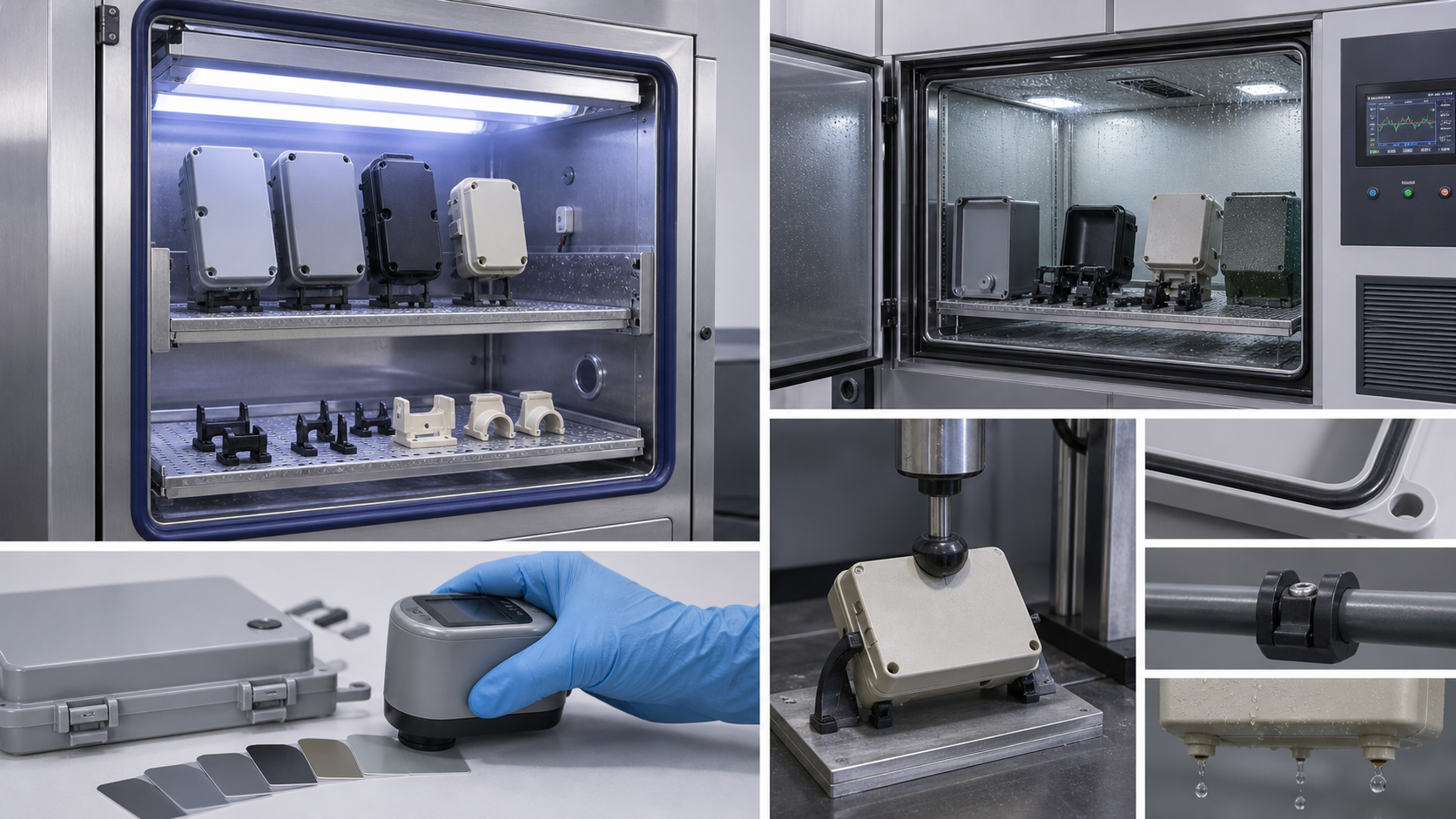
ASTM G154, ASTM G155 or ISO 4892 may be relevant when the project specifies accelerated weathering, but test duration and apparatus do not create a universal service-life conversion. The resin grade, specimen geometry, irradiance, temperature, condensation and acceptance criteria must be recorded with the result.
Use the same color, texture, wall thickness and molding direction in test specimens whenever possible. A polished plaque may weather differently from a textured production housing, and a flat coupon cannot reveal stress around a screw boss or snap-fit. For higher-risk parts, combine material testing with a production pilot and inspect cosmetic and functional features after exposure.
Outdoor Plastic RFQ Checklist
- Climate, UV intensity, latitude, altitude and expected exposure duration
- Temperature range, cycling rate, humidity, rain, salt and freeze exposure
- Load, impact, vibration, fastener stress and expected service life
- Color, gloss, texture, allowable fading and cosmetic boundary
- Candidate resin, stabilizer package, pigment and approved equivalents
- Process route, wall thickness, inserts, seals and assembly conditions
- Required weathering method, specimen, conditioning and acceptance limits
Define whether appearance or mechanical retention is the controlling requirement. Some outdoor applications can accept a small color shift, while others require stable gloss or color across a large visible surface. For load-bearing or safety-related parts, retain strength and impact data after the relevant exposure instead of approving the resin from an unexposed datasheet alone. This makes the material decision easier to defend during design review and supplier qualification.
Weather-resistant plastics should be selected against the actual UV dose, moisture, temperature cycling and cosmetic life expected outdoors.
For production outdoor parts, compare this material choice with our injection molding services và plastic material guide.
Câu hỏi thường gặp
Which plastic lasts longest outdoors?
There is no universal winner. ASA, qualified UV-stabilized grades, PC, PP, PBT and selected nylon grades can work when the exact environment, load, color and service life are matched to evidence.
Is ABS UV resistant?
Standard ABS has limitations outdoors. An outdoor-qualified ABS or ASA grade may be suitable, but request grade-specific UV, color and impact-retention data.
How is weather resistance tested?
Projects may use accelerated methods such as ASTM G154, ASTM G155 or ISO 4892, together with actual outdoor exposure when risk is high. The test conditions and acceptance limits must be defined.
Does black color improve UV life?
Carbon black can improve protection in some polymer systems, but color alone is not proof. Dispersion, stabilizer package, base resin and the actual grade still need verification.
Which outdoor plastics can be injection molded?
ASA, UV-stabilized ABS, PC, PP, PBT and selected reinforced nylons can be molded. The right option depends on heat, impact, moisture, chemicals, appearance and volume.