The cavity generally forms the exterior of a molded part, and the core forms features such as bores, recesses and internal walls. Review the parting line, gate, cooling and ejection together. Cosmetic faces and functional dimensions should drive where these features are placed.
Dành cho các đội ngũ kỹ thuật và mua hàng
Có nên rà soát lại thiết kế lõi và khuôn trước khi chế tạo khuôn không?
Các quyết định liên quan đến lõi và khoang khuôn sẽ quyết định đường phân khuôn, góc nghiêng, hệ thống làm mát, cơ chế đẩy sản phẩm ra và nhiều nguyên nhân gây ra phần thừa hoặc biến dạng. Cần rà soát kỹ các yếu tố này dựa trên loại nhựa thực tế và kế hoạch kiểm tra trước khi tiến hành gia công thép khuôn.
- Xác nhận các yêu cầu về đường phân chia và cơ cấu tác động bên từ mô hình CAD
- Nên kiểm tra đồng thời hệ thống làm mát, van và cơ chế đẩy ra thay vì kiểm tra từng phần riêng biệt
- Xác định các vùng thẩm mỹ, dung sai và khối lượng sản xuất hàng năm trước khi phê duyệt khuôn mẫu
Yêu cầu đánh giá DFM cho lõi và khuôn → Xem các dịch vụ đúc ép nylon
Hiểu rõ các nguyên lý cơ bản về lõi và khoang
The cavity often forms the outside profile and the core forms the inside profile. In a conventional two-plate tool, the core is often on the moving side, but the part geometry, retention and ejection plan determine the arrangement. See the Protolabs guide to core and cavity placement.

At DFM review, agree on visible witness lines, locations where flash could affect assembly, and how the part will remain on the intended side before ejection.
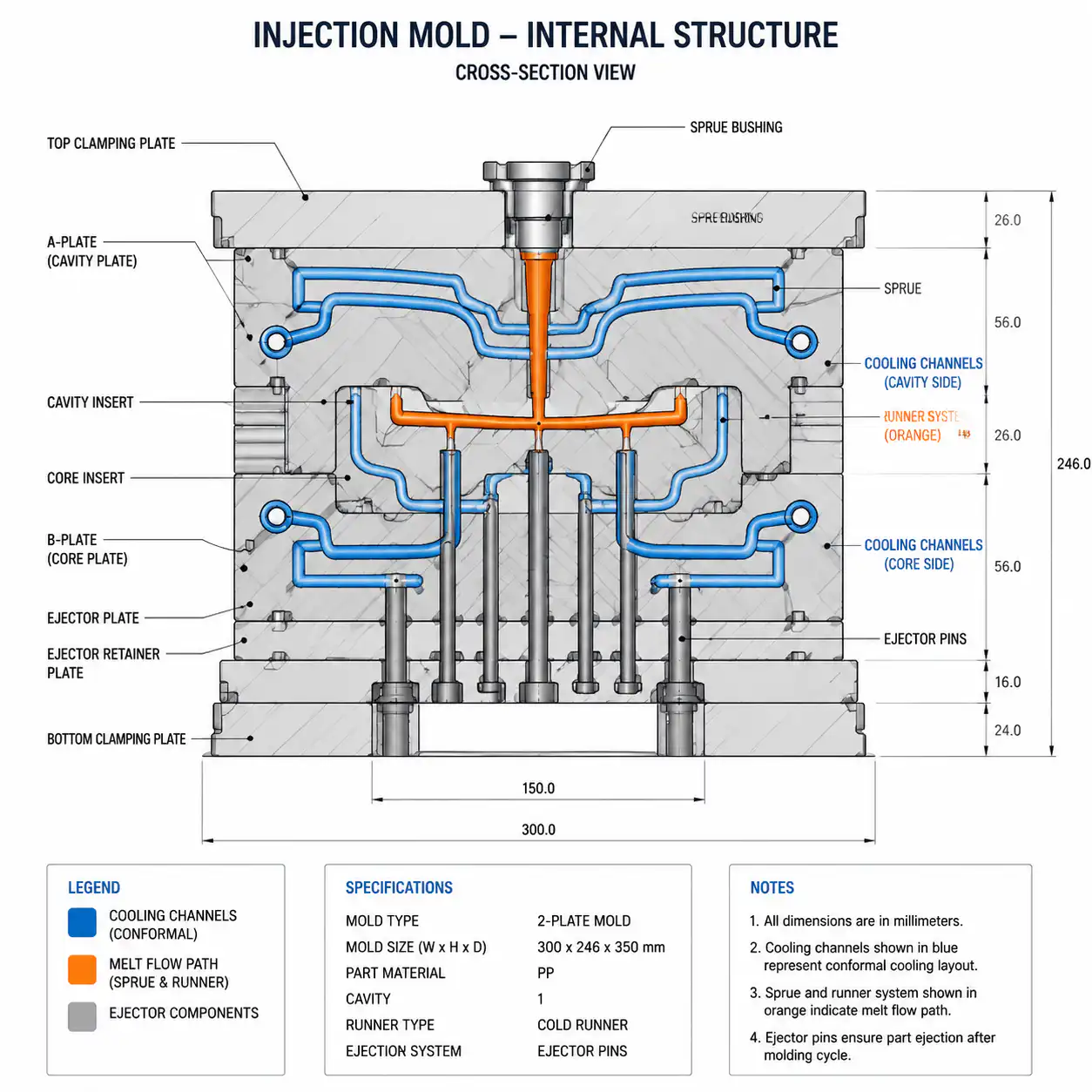
Chiến lược đường phân chia: Nơi hình thức hòa quyện với chức năng
Đường phân chia là vị trí mà nửa lõi và nửa khuôn tách ra khỏi nhau, và việc xác định vị trí của nó là quyết định quan trọng nhất trong thiết kế khuôn. Một đường phân chia phẳng, nằm trên một mặt phẳng duy nhất là phương án đơn giản nhất và ít tốn kém nhất — nhưng các chi tiết thực tế hiếm khi cho phép sự thuận lợi đó. Đường phân chia bậc thang tuân theo hình học của chi tiết khi các đặc điểm cấu trúc không cho phép phân chia phẳng, làm tăng chi phí khuôn mẫu khoảng 10–15% đồng thời giải quyết các tình huống cắt ngược mà không cần cơ cấu phụ. Khi các chi tiết có lỗ hoặc các đặc điểm vuông góc với hướng mở khuôn, các cơ cấu phụ (còn gọi là thanh trượt hoặc bộ nâng) sẽ mở rộng đường phân chia thành ba chiều, làm tăng độ phức tạp của khuôn lên 20-40% và thời gian chu kỳ thêm 2-5 giây cho mỗi cơ cấu phụ.
Việc bố trí đường phân chia chiến lược giúp giảm thiểu các vết hằn nhìn thấy được trên bề mặt thẩm mỹ. Đối với các sản phẩm dành cho người tiêu dùng, hãy bố trí đường phân chia dọc theo các cạnh tự nhiên hoặc các điểm chuyển tiếp thay vì cắt ngang qua các mặt phẳng rộng. Khi gia công vật liệu có chứa sợi thủy tinh, hãy giữ đường phân chia cách các góc nhọn ít nhất 0,5 mm để tránh hiện tượng sứt mẻ trong quá trình đẩy sản phẩm ra khỏi khuôn. Đối với khuôn nhiều khoang, đảm bảo mặt phẳng đường phân chia nhất quán trên tất cả các khoang để duy trì sự phân bố lực kẹp đồng đều. Sự sai lệch đường phân chia chỉ 0,03 mm cũng tạo ra phần thừa có thể nhìn thấy, gây tốn kém chi phí thực tế trong các công đoạn cắt bỏ phần thừa thứ cấp — thường là $0,05-$0,15 cho mỗi chi tiết khi cắt bằng tay, hoặc $0.02–$0.05 cho quá trình cắt tự động bằng máy lăn.
Draft Review for Cores and Cavities
Choose draft for the release direction, resin, depth, texture and ejection method. Internal features can grip the core as the part shrinks, so inspect deep sections separately.
Review textured faces with the toolmaker and texture supplier. Mark areas where draft or witness lines could alter fit, appearance or a sealing face.
| Tính năng | Draft review | Cần kiểm tra những gì |
|---|---|---|
| Deep core | Review depth, texture and resin grip. | Check scuffing, distortion and ejection force on samples. |
| Rib or boss | Check each side relative to the release direction. | Confirm local wall thickness and functional fit. |
| Cosmetic wall | Coordinate the surface finish and pull direction. | Compare witness lines and marks to the appearance sample. |
| Shutoff or undercut | Review release, steel contact and any side action. | Confirm flash acceptance and maintenance access. |
Cooling Layout and Dimensional Stability
Cooling layout affects dimensional consistency and cycle time. Ask the toolmaker to identify isolated core tips, thick sections and regions with limited water access. Use trial parts to verify distortion and dimensional repeatability.
Deep or narrow cores can have limited space for channels. Review conventional channels, baffles or conformal cooling against tool strength, maintenance access and the actual heat load.
Vị trí đặt bộ đẩy: Tháo phôi ra mà không gây hư hỏng
Vị trí của chốt đẩy quyết định liệu chi tiết của bạn có bật ra một cách gọn gàng hay xuất hiện các vết biến dạng, dấu vết căng thẳng và những đường tròn đặc trưng cho việc thiết kế chốt đẩy không hợp lý. Quy tắc cơ bản: đẩy sản phẩm ra tại vị trí mà sản phẩm có độ cứng cao nhất, chứ không phải tại vị trí thuận tiện nhất cho bố trí khung khuôn. Đẩy sản phẩm từ phía sau các gân và chốt, tuyệt đối không đẩy vào các thành mỏng không được hỗ trợ vì chúng sẽ bị uốn cong. Chốt đẩy phải tiếp xúc với chi tiết qua mặt B (mặt lõi), và tổng diện tích đẩy phải đủ để vượt qua lực bám dính của chi tiết với lõi — đối với các chi tiết kéo sâu có độ nghiêng tối thiểu, lực giữ này có thể vượt quá 50 MPa.
Use the cosmetic and functional requirements to decide where pin marks are acceptable. Review blades, sleeves or a stripper plate where the geometry needs a different distribution of ejection force.
- Check wall transitions, ribs and bosses where thick areas could affect sink or warpage.
- Mark critical dimensions, cosmetic faces, undercuts and the intended release direction.
- Review gates, cooling and ejector positions on the same tool concept before sign-off.

Ma trận ứng dụng trong ngành
| Ứng dụng | Core and cavity review focus |
|---|---|
| Automotive bracket | Identify assembly datums, witness lines and loaded bosses. |
| Electronics enclosure | Check connector opening, seal face, exterior finish and ejector marks. |
| Medical equipment housing | Review cleanable geometry, acceptance criteria and any required documentation. |
| Industrial housing | Review ribs, threaded inserts, replaceable details and inspection access. |
Cost Decision Framework: Core-Cavity Design Economics
Compare tooling quotes using the same cavity count, tool material, surface finish, side actions, sample rounds and inspection scope. Ask each supplier to separate tooling, qualification and recurring production costs.
- Compare one-cavity and multicavity options against the launch and repeat-order quantities.
- Ask which side actions, inserts and maintenance items are included in the quote.
- Agree how sample approval and dimensional reports will be handled before production.
For a volume comparison, spread the one-time tooling cost over the expected accepted quantity and add the quoted part, secondary-operation and inspection costs. State how scrap, tool maintenance and design changes are treated.
Common Core-Cavity Defects and Solutions
| Lỗi | What to inspect before changing the tool |
|---|---|
| Parting-line flash | Check shutoff contact and tool alignment, then review the process window and clamp settings. |
| Scuffing or drag | Check draft, texture and part retention on the core. |
| Sự cong vênh | Review wall thickness, gate orientation, cooling balance and conditioning after molding. |
| Ejector marks | Check support, pin position, local wall thickness and ejection timing. |
Tại sao nên chọn nhựa nylon cho dự án của bạn?
Sản xuất chính xác
Hơn 30 dây chuyền gia công CNC và ép phun tập trung tại cùng một địa điểm
Đạt chứng nhận ISO 9001:2015
Hệ thống quản lý chất lượng được chứng nhận, báo cáo kiểm tra đầy đủ
Thời gian giao hàng từ 15 đến 25 ngày
Thời gian hoàn thành nhanh chóng, có các tùy chọn xử lý khẩn cấp
Vận chuyển toàn cầu
Vận chuyển hàng hóa bằng đường hàng không và đường biển đến Bắc Mỹ, châu Âu, châu Á
Download Our Core & Cavity Design Guide
Tài liệu tham khảo PDF miễn phí bao gồm các bảng lựa chọn vật liệu, quy tắc thiết kế và danh sách kiểm tra đánh giá nhà cung cấp.
Các bài viết liên quan
Complete guide to A/B/C/D finish grades for injection molds
Edge treatment selection for manufacturability and strength
ISO 2768 and DIN standards for plastic part tolerances
Process selection guide for prototyping and production

Câu hỏi thường gặp
What’s the difference between the core and cavity in injection molding?
The cavity generally forms the exterior, and the core generally forms recesses, bores and internal surfaces. Assign fixed and moving sides based on the gate, part retention and ejection arrangement.
Góc nghiêng tối thiểu cho lõi sâu là bao nhiêu?
There is no single minimum for every deep core. The toolmaker should review depth, resin shrinkage, texture, release direction and ejector access together.
Làm thế nào để ngăn chặn hiện tượng lóe sáng tại đường phân chia?
Inspect the location and repeatability of the flash. Verify shutoff condition, tool alignment, clamp and process settings before making changes. Agree what is acceptable at sealing and mating surfaces.
Tôi có thể làm mát bằng nước cho các lõi sâu một cách hiệu quả không?
Deep-core cooling depends on space for channels, required core strength and operating conditions. Review the channel layout with the toolmaker and measure whether sample temperatures and dimensions stabilize during a trial.
Nguồn thông tin kỹ thuật và việc xác minh
Hãy sử dụng dữ liệu của nhà cung cấp như một nguồn tham khảo để xác minh, chứ không phải để thay thế cho việc thử nghiệm chính xác loại vật liệu và chi tiết đó trong các điều kiện vận hành dự kiến.
Buyer Checklist Before Core and Cavity Review
| Review Point | Buyer Should Confirm | Tại sao điều này lại quan trọng |
|---|---|---|
| Parting line | Can it hide flash risk and support clean ejection? | Parting line choice affects tool life and cosmetic quality |
| Cooling layout | Are hot spots and cycle time targets defined? | Poor cooling leads to warp, sink and unstable output |
| Chiến lược cổng | Is fill balance more important than gate visibility? | Gate location changes weld lines and shrink behavior |
| Phóng ra | Will the part release without mark-sensitive damage? | Too much ejection force causes scuffing and distortion |
For a mold design review, attach the CAD model and controlled drawing. Mark cosmetic faces, critical fits, insert locations and annual volume. Note the requested sample and inspection records.